




People development is facing a new role today. While the focus used to be on organizing training, it is now increasingly about supporting organizations in strengthening their long-term viability.
Many companies are currently operating in an environment shaped by economic uncertainty, cost pressure, and continuous change. New technologies such as artificial intelligence are transforming business models and ways of working. At the same time, demands on employees and leaders are increasing. Providing orientation, making decisions, and dealing with uncertainty are becoming part of everyday work.
The troodi L&D Trend Report 2026 shows which challenges are particularly relevant and what role L&D can play in this context.
This is exactly where Learning & Development comes into play. L&D is evolving from a training provider into a strategic partner that supports organizations in adapting to new demands and remaining effective and future-ready in the long term.
The troodi L&D Trend Report 2026 shows which challenges are particularly relevant and what role L&D can play in this context.
The biggest challenges for L&D in economically volatile times
The results of the Trend Report show that L&D teams are currently dealing with several key areas of tension.
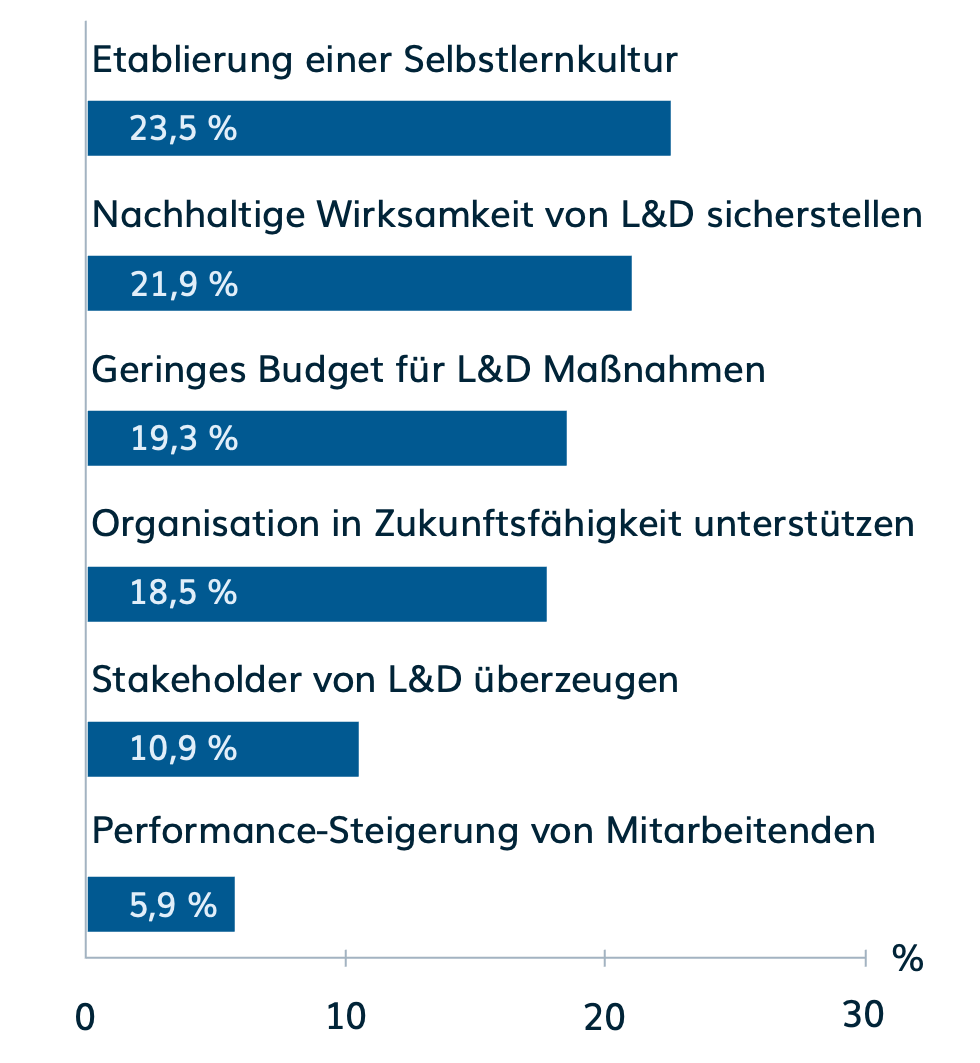
A central topic is the establishment of an active learning culture. Organizations need employees who take ownership of their learning and continuously develop. At the same time, in practice, learning is often not yet naturally integrated into everyday work. L&D is therefore faced with the task of creating the right conditions and embedding learning more strongly into daily work.
Another key topic is demonstrating impact. Especially in economically challenging times, there is increased scrutiny of how learning initiatives contribute to business success. L&D needs to more clearly show how its measures support team performance and help organizations navigate change.
In addition, cost pressure is increasing. Budgets are limited while expectations remain high. This means that programs need to be clearly prioritized, more closely aligned with strategic topics, and designed to scale efficiently.
At the same time, expectations for L&D to actively contribute to the organization’s future viability are increasing. Alongside fostering self-directed learning, there is a growing focus on the targeted development of specific skills. Skill-based approaches are gaining importance and complement traditional learning formats.

How L&D can support organizations in practical terms
The Trend Report highlights several key levers through which L&D can effectively support organizations in volatile times.
Strengthening change competence and resilience
The most frequently cited contribution of L&D lies in building competencies for dealing with change. Employees and leaders need to learn how to navigate uncertainty, actively shape change, and adapt more quickly to new demands.
This can be supported through change leadership programs, learning impulses on transformation topics, or targeted reflection spaces where experiences can be processed and transferred.
Translating company strategy into everyday work
L&D plays an important role in making strategic topics tangible. Learning and exchange formats can help communicate complex business goals in an understandable way and translate them into concrete actions for teams.
This ensures that strategy is not only communicated but also embedded in everyday work.
Systematically analyzing and developing skills
Another key lever is the systematic development of competencies. This includes defining relevant skills, making existing gaps visible, and deriving targeted learning paths.
The focus is on areas such as future skills, AI competencies, and leadership competencies. The goal is to ensure that development is not left to chance, but structured in a deliberate way.
Increasing efficiency in everyday work
L&D can also help make work processes more efficient. Short, problem-oriented learning formats, targeted process training, and exchange formats for best practices help reduce friction in everyday work.
At the same time, building scalable learning solutions is becoming increasingly important. Content is designed in a way that makes it accessible to larger target groups while remaining flexible enough to be adapted to different contexts.
Strategic alignment: Why alignment is critical
Whether L&D can fulfill its role as a strategic partner depends largely on how closely its activities are aligned with business goals.
The results of the Trend Report show a mixed picture. In 41.2 percent of organizations, L&D is clearly aligned with strategic direction. 22.7 percent take business goals into account at least partially. At the same time, nearly one-third operate without a clearly defined L&D strategy.
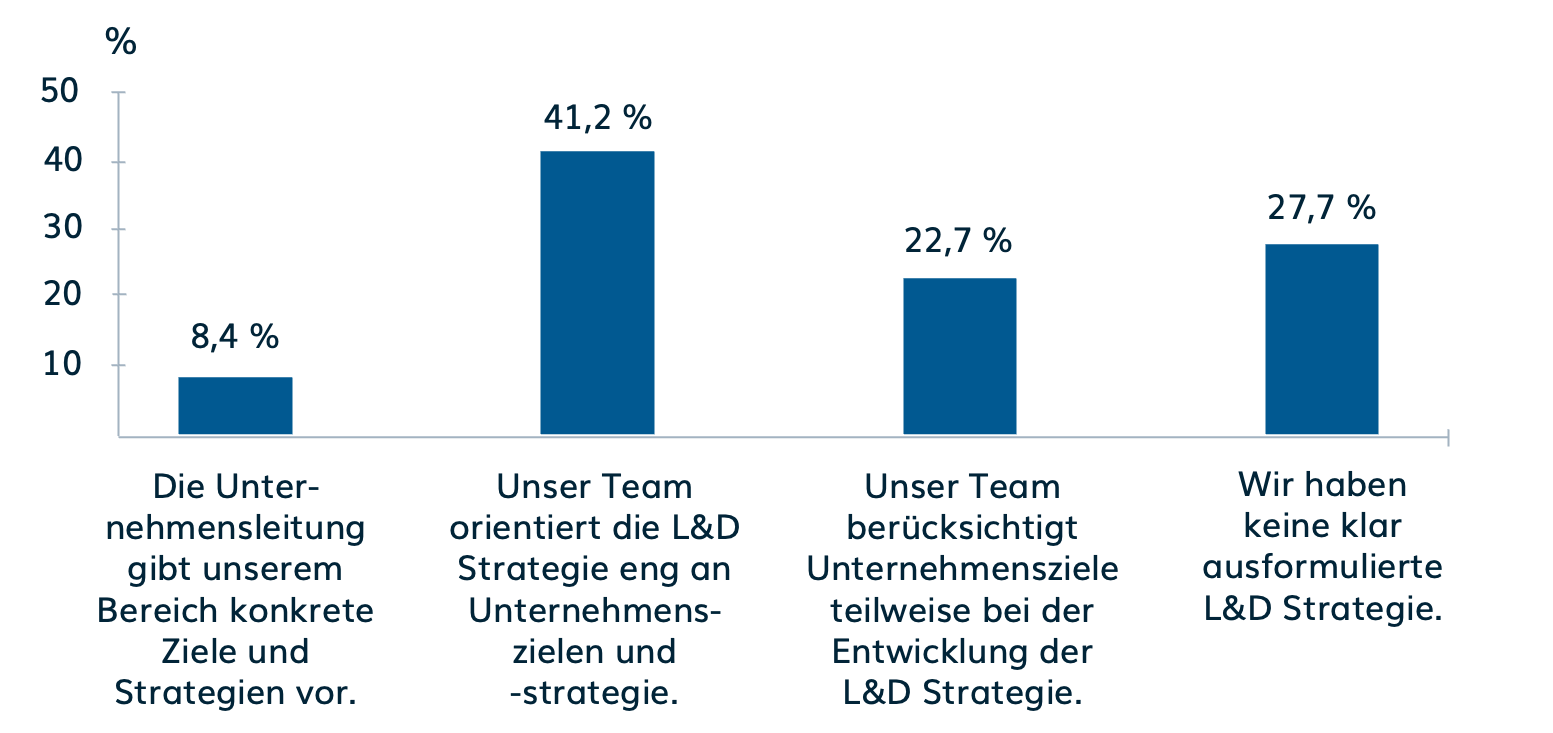
These differences have a direct impact on effectiveness. Without strategic alignment, L&D often remains operational and reactive. With a clear direction, however, L&D can actively contribute to supporting key business goals.
Close collaboration with leaders and business units is essential. Real value only emerges when strategic goals, operational challenges, and learning initiatives are closely aligned.
The opportunity for L&D
Learning & Development is currently operating in a field of tension shaped by economic uncertainty, technological change, and increasing expectations for impact.
At the same time, this very environment creates a significant opportunity. If learning initiatives are consistently aligned with strategic goals, competencies are developed systematically, and effective learning formats are implemented, L&D can become a key partner in strengthening the long-term viability of organizations.
The key is to view people development not as a one-off initiative, but as a continuous process. This is how development is created that not only builds knowledge but generates lasting impact.
Learn more about the key trends and challenges in people development in our L&D Trend Report 2026.