


L&D Focus Topic 2026: Leadership Competencies

Icon_Calendar

February 11, 2026

Leadership competencies will be a central focus of people development in 2026. Especially in economically challenging times, the question comes to the forefront of how leaders can provide orientation without undermining responsibility and innovative capacity within their teams. Moderating leadership can offer one possible answer.

Moderating leadership as a response to uncertainty and pressure to change

Why leadership competencies are the central L&D focus topic for 2026

Which topics will be at the center of Learning & Development in the coming year?

This is a question we ask ourselves at troodi every year as part of the L&D Trend Report 2026. The annual survey is aimed at people development professionals, L&D leaders, and HR generalists and highlights which competency areas are currently gaining importance in organizations and which are expected to become more relevant in the future.

Leadership is moving into the focus of people development

The results of the current report are clear: leadership competencies are at the very top of the people development agenda in 2026. Especially in economically challenging times marked by uncertainty, efficiency pressure, and constant change, the question becomes central: how can leadership provide orientation without diminishing responsibility and innovative capacity within teams?

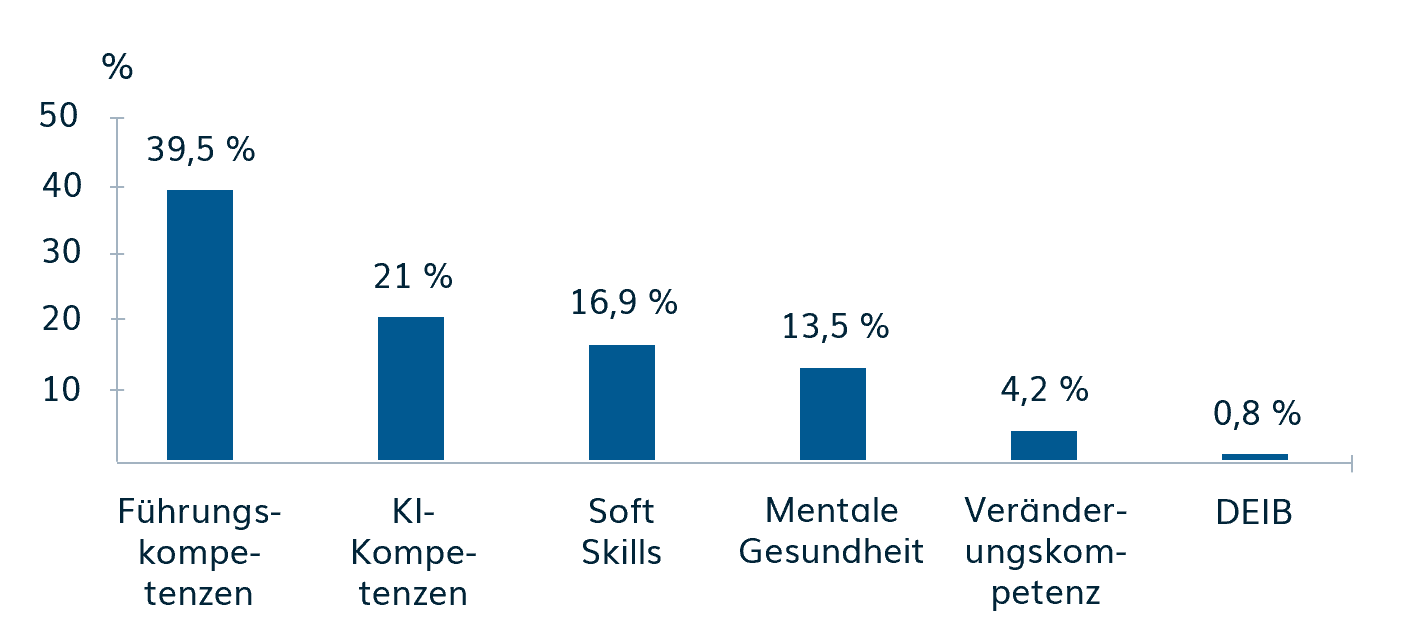
The analysis from the L&D Trend Report 2026 clearly underscores this finding: leadership competencies are by far the most frequently cited focus topic among respondents. Nearly 40 percent prioritize the development of leadership competencies clearly ahead of AI-related skills, soft skills, or mental health.

As an answer to the question of how organizations can respond to uncertainty, pressure to change, and growing complexity while remaining sustainably capable of action, troodi CEO Philip Klasen-Schwidetzki developed the model of moderating leadership. In the interview, he explains why many organizations revert to classic top-down patterns under pressure and how moderating leadership can help combine performance and participation.

Philip, the Trend Report makes it clear that many organizations are currently under economic pressure while also having to navigate constant change. In this environment, where do you see the greatest challenge for leaders?

I experience the greatest challenge as a field of tension: on the one hand, economic pressure, performance targets, and efficiency expectations; on the other, teams that need orientation. Under this pressure, leadership quickly shifts toward more directives, more control, and more top-down decision-making. In the short term, this can feel effective; in the long term, people think less for themselves and take on less responsibility. Ultimately, this weakens the team’s capacity for innovation.

At the same time, leaders themselves are part of this uncertainty – this becomes clear, for example, when it comes to AI. Many know they need to engage with it, but wait until they feel technically “ready,” instead of shaping the learning process together with their team.

If I sum it up, the core challenge is this: providing orientation without slipping into micromanagement. In other words, designing frameworks and processes in a way that allows teams to remain accountable even in times of crisis – and, put pointedly, to truly use “everyone’s brains.” That requires less of the doer reflex at the top and more of an enabler mindset: someone who steers the process thoughtfully and involves the team in a serious and meaningful way.

The survey shows that leadership topics continue to be among the most frequently requested learning areas. The demand for leadership competencies is therefore high, especially in volatile times. If top-down leadership is not a sustainable solution, what competencies do leaders need in the face of these challenges?

I believe that focusing solely on the question “top-down or not?” does not get us very far—the key issue is what enables leadership to hold this pressure and uncertainty effectively. For me, there are three core competency areas that are particularly relevant in times like these.

The first is a clear awareness of roles and responsibilities. Under pressure, many leaders slip into the role of the “person responsible for everything” – and in doing so, take away exactly the responsibility they actually want to strengthen in their teams. Moderating leadership, for me, means consciously deciding when I set the framework and direction and when I open up space, ask questions, and involve the team in finding solutions.

The second is process competence: I do not need to have all the answers, but I do need a solid path to get there – who is at the table, which steps we take, and how we make decisions. When leadership is less about “the perfect solution” and more about a clearly structured process, teams remain capable of action even when goals or conditions change.

And third, it requires concrete facilitation and communication skills: structuring conversations so that everyone has a voice, making decisions visible, setting clear agreements, and asking strong questions instead of immediately judging. That may sound simple, but it is often the difference between meetings where everyone waits for instructions and discussions where real thinking and decision-making take place. It is not about leaders becoming professional facilitators, but about having enough facilitation know-how to provide orientation while at the same time strengthening their team’s ownership and responsibility.

Many decision-makers initially worry: “If I lead in a more moderating way, we will lose speed and clarity.” How do you respond to this concern – especially given that organizations are under pressure to become more efficient?

I hear this concern very often – and I understand it. If we think of “moderation” only as long discussions with lots of participation and colorful sticky notes, it can indeed sound like less speed and less clarity at first. In practice, however, I experience the exact opposite: well-facilitated processes speed up decisions and make them clearer. If I take three or four minutes at the beginning of a meeting to clarify the goal, agenda, and roles – a brief contracting phase – I save significantly more time later by avoiding loops and misunderstandings.

What matters to me is this: moderating leadership does not mean discussing everything with everyone all the time. It means consciously deciding when participation makes sense and when a clear decision is needed. In times of crisis, there may be phases in which I set the framework very clearly—but I can shape it in a way that keeps the team thinking along and taking responsibility, rather than pushing every decision back to me. That is why I would say moderating leadership is a highly pragmatic response to efficiency pressure: it helps reach clear decisions faster while involving the team in a way that encourages ownership instead of waiting for the next instruction.

So does moderating leadership actually help increase team performance?

From my perspective, yes – it does, provided it is practiced seriously. Moderating leadership is not a soft-skill label for me, but a very concrete way of organizing performance within a team without controlling everything through my own role. When people understand what it is about, what contribution is expected from them, and how decisions are made, commitment increases – and with it the likelihood that things actually get done. In practice, I see teams raising issues earlier, renegotiating decisions less often, and coordinating tasks more clearly among themselves. Of course, this does not relieve me of the responsibility to make unpopular decisions at times, but the path to those decisions is different: the team has been involved, can understand the decision, and is more likely to support implementation rather than holding back internally.

And what role do you see for L&D teams in this field of tension? What can they do to ensure that it does not stop at attending a training, but that leaders truly embed moderating leadership as a response to pressure to change and efficiency demands in their everyday work?

I see L&D in a dual role here: as an architect of learning offerings and as a sparring partner to the organization. If leaders are expected not just to have “heard about” moderating leadership but to truly live it, booking a single training and hoping for a major mindset shift is, in my view, not enough.

A first lever is to consistently align learning offerings with real leadership situations and avoid abstract models in favor of typical everyday settings – critical team meetings, difficult decisions, and change processes marked by a high degree of uncertainty. When leaders work with their real cases in training and practice moderation and process skills in that context, the likelihood that they will apply these approaches in everyday work is significantly higher.

The second lever is transfer support. Moderating leadership is a behavioral change that rarely happens within two days of training. L&D can use short followups, peer groups, or digital nudges to ensure that leaders stay engaged and reflect in very concrete terms: “Which meeting will I facilitate differently next week? What will I try out?”

And third, L&D can embed moderating leadership into systems and processes—into leadership principles, feedback formats, and goal-setting and development conversations. When I, as a leader, notice that my approach to participation and decision-making is not only addressed in training but truly embedded in the organization, its relevance increases. This is how leadership training gradually becomes a mindset that enables leaders to respond to uncertainty and efficiency pressure.

Deliberately shaping moderating leadership

The results of the L&D Trend Report 2026 clearly show that leadership competencies are and will remain a central field of action for people development. Moderating leadership offers a pragmatic approach to combining orientation, participation, and efficiency.

In theModerating Leadership learning program we address these challenges in a targeted way. Leaders reflect on their role, strengthen their process and facilitation skills, and learn how to design meetings, decision-making processes, and change situations in a clear and effective way.

Watch the trailer for the learning program and feel free to reach out if you are interested. We would be happy to advise you on how moderating leadership can be embedded in your organization.

Lynn Tamberger
L&D Consultant
Lynn Tamberger ist L&D Consultant bei troodi mit einschlägiger Erfahrung in den Bereichen Content-Konzeption, Projektmanagement und Kommunikation. Ihr Fokus liegt auf der Entwicklung moderner Lernformate und der Begleitung von Organisationen in Veränderungsprozessen. Besonders interessiert sie sich für digitales Lernen, persönliche Entwicklung und die Frage, wie Zusammenarbeit zukunftsfähig gestaltet werden kann.

Other interesting blog posts

Delivering Difficult Messages

Leaders can deliver difficult messages in a way that maintains clarity, empathy, and trust. Preparation, mindset, structured communication, and reflection form the foundation for confident action in challenging situations and help strengthen team collaboration.

What is Change Competence?

What is Change Competence?

Change is no longer an exceptional state but everyday life. Digitalization, new work models, constantly changing demands: change has become the new normal. However, not everyone copes with it equally well. The challenge often lies not in the change itself but in how it is handled. This blog article examines change competence and how it can be strengthened individually.