


Sustainably effective leadership development

Icon_Calendar

March 3, 2026

Leadership development faces the challenge of creating lasting impact and moving beyond standalone training formats. Blended learning journeys provide a structured framework to systematically connect knowledge, reflection, and practical transfer, strengthening leadership in a sustainable way.

Why is it so difficult for us to deliver difficult messages?

Leadership is changing in noticeable ways. Economic uncertainty, hybrid work models, increasing complexity, and technological developments such as artificial intelligence are shaping the new reality of organizations and their leaders. Decisions need to be made more quickly. Providing orientation is becoming more important. At the same time, expectations around participation, communication, and ownership within teams are increasing.

In this environment, it is not enough to teach individual tools or methods. Leaders need more than a toolbox. They need mindset, the ability to reflect, and confidence in applying what they have learned in practice.

This raises a central question for people development: how can leadership development be designed in a way that creates lasting impact?

What defines an effective development format?

For people development professionals, designing effective leadership development means ensuring that formats not only convey knowledge but enable lasting change. Several quality criteria play a central role in this.

Effectively supporting transfer

Knowledge alone does not change behavior. What matters is applying it in everyday leadership situations. Sustainable competency development emerges when leaders try out new approaches in their daily work and reflect on them.

Effective programs therefore combine:


  • Input with concrete, practice-oriented tasks
  • Reflection with feedback
  • Learning with application in one’s own team
Enable individualization

Leaders bring different roles, experiences, and time constraints. Development formats should therefore be designed with flexibility in mind and take individual needs into account. This includes modular learning content, flexible pacing, and the ability to set individual priorities. This creates a learning process that provides structure while still allowing room for personalization.

Create experience and social engagement

People do not learn purely on a cognitive level. Emotion, interaction, and dialogue significantly strengthen learning outcomes. Exchange with peers and feedback from different perspectives, for example from one’s own manager and team members, help ensure that learning content is retained more sustainably.

Foster behavior change

Sustainable development requires repetition and support. Development programs should therefore be designed to create regular touchpoints. When leaders continue to reflect on applying what they have learned beyond the training itself, the likelihood of lasting learning transfer increases.

What learning research suggests

  • Spacing: learning over time is more effective than compact, intensive formats.
  • Testing: active application strengthens long-term retention.
  • Social reinforcement: feedback increases motivation and transfer.
  • Context relevance: learning is more effective when it is applied in one’s own work environment.

These principles are supported by numerous studies in learning and transfer research (e.g., Cepeda et al., 2006; Roediger & Karpicke, 2006).

How can these success criteria be translated into concrete development concepts? Blended learning journeys are designed to incorporate these principles and provide a suitable framework. A blended learning journey is a deliberately structured learning process that combines different formats into a holistic concept. Learning is not seen as a one-time event, but as a long-term development process over an extended period.

Typical elements include:

  • Digital self learning
  • Live training
  • Peer and community sessions
  • Transfer formats

Components of an effective learning journey

a) E-learning

Digital learning programs enable flexible learning and create a shared foundation of knowledge. Leaders engage with theoretical concepts independently and reflect on their own practice. Interactive elements, quizzes, and short case examples increase engagement and support self-assessment. This creates a structured entry into new topics that can take place anytime and anywhere.

b) Live-sessions

In live sessions, content is deepened and reflected on together. Leaders discuss real cases, try out methods, and receive feedback from trainers and other participants. Through high engagement and direct exchange, theoretical knowledge is translated into practical competence.

c) Application phase

Between modules, time is deliberately allocated for transfer. Leaders apply new insights within their own teams, experiment with methods, and reflect on real leadership situations. This phase is critical, as it is where learning turns into actual behavior change.

d) Social-learning

Social learning formats such as peer exchange, tandems, or community sessions encourage perspective-taking and accountability. Dialogue with peers helps participants view challenges from different angles and learn from one another. At the same time, regular exchange strengthens motivation to consistently apply new approaches.

e) Sparring and individual support

In individual sparring sessions, leaders are given space to address personal questions. One-on-one reflection makes it possible to analyze specific situations and work on individual development topics in a targeted way. Especially in complex leadership challenges, this form of support offers high transfer value.

f) Serious games and simulations

Serious games and simulations create realistic learning situations in which leaders can practice decision-making. Through emotional engagement and perspective shifts, insights are often retained more sustainably. At the same time, these formats encourage the confidence to apply new approaches and a willingness to experiment.

A look into practice: Leadership development as a blended learning journey

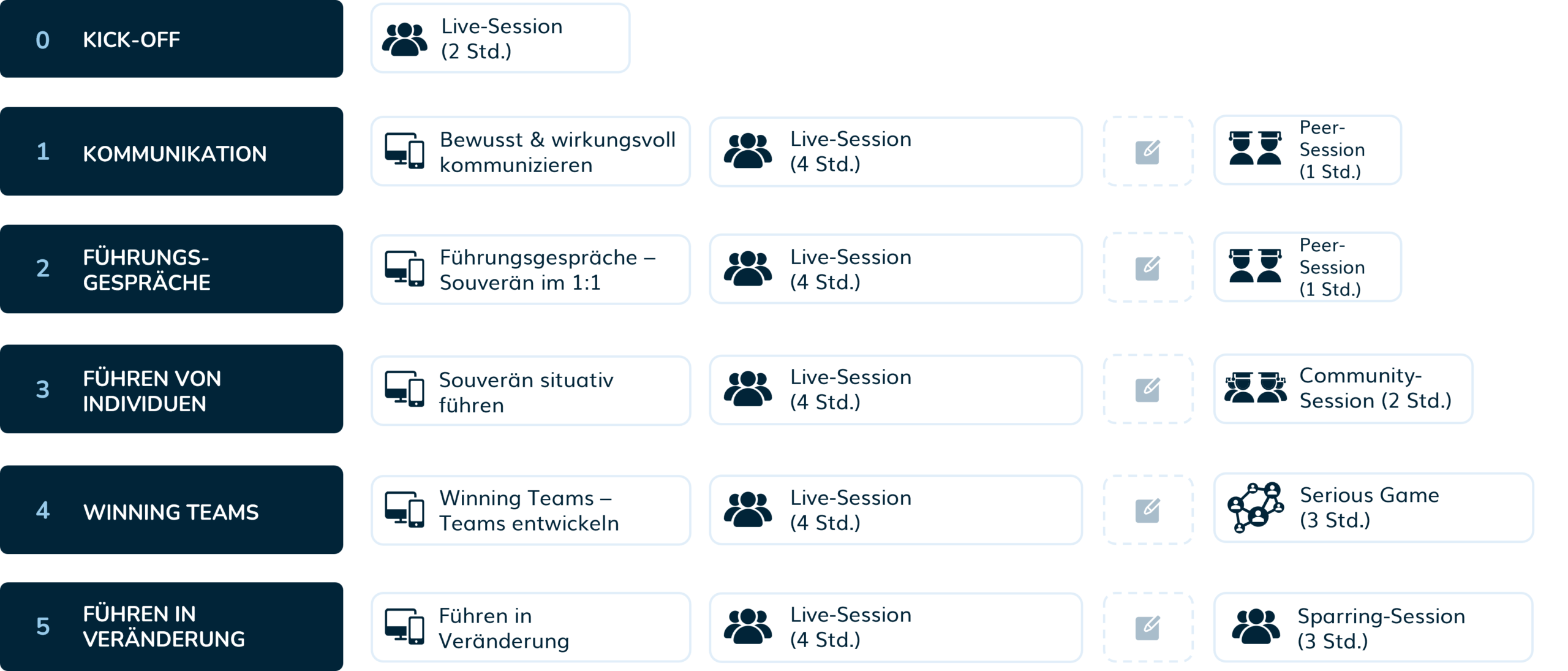
Leadership development can be designed in very different ways. Depending on the starting point, the organization, and the level of leadership experience, content and formats are selected based on specific needs. troodi’s open leadership development program runs over six to eight months and equips leaders with the essential fundamentals of leadership. From intentional communication and confident conversations to leading entire teams, participants develop an empathetic, performance- and results-oriented understanding of leadership.

The structure combines multiple learning formats into a holistic development process. It includes clearly structured modules with several components:

  • Digital learning program for knowledge acquisition,
  • Live session with a trainer for deeper exploration and case work,
  • Clearly defined application phase for transfer into the work context.

With a deliberate time gap after the training, each module concludes with one of the following components:

  • Asocial learning unit such as a peer or community session for reflection and exchange of experiences
  • A serious game for a playful transfer of learning content
  • Sparring session for personal reflection with the trainer
Continuous activation over several months is particularly effective. Instead of a one-time impulse, a learning process emerges that regularly engages leaders with new perspectives, reflection questions, and practical application tasks. This keeps the topic present in everyday work rather than being overshadowed by operational demands.

A central component is the deliberately planned application phase. Leaders apply what they have learned within their own teams, try out methods, and gather concrete experiences. This practice phase is an integral part of the journey. In a follow-up session, participants reflect on their experiences together, discuss challenges, and adjust their approach. It is precisely this combination of application and shared reflection that strengthens sustainable transfer.

The individual components build on each other in a systematic way. Content is prepared, deepened, applied, and reflected upon. This creates a clear thread that provides orientation and makes development transparent.

Small groups with a high level of interaction further enhance relevance and trust. Leaders work on their own cases, receive individual feedback, and benefit from the exchange of experiences with other participants. In this way, learning becomes personal, practical, and directly applicable to their everyday leadership context.

Leaders do not experience development as an isolated training, but as a structured process that supports them over a longer period of time and creates a noticeable impact.

“Since troodi has become our trusted partner for leadership training, I have noticed a positive change in communication within our team. Conversations are now more structured, clearer, and more efficient. Everyone who has participated in the program uses the tools from the training on a daily basis. Personally, I consider this to be the best program I have ever taken part in. I am more convinced than ever that all the insights and tools I have gained will have a lasting impact on me as a leader, on how I am led, and on all my future conversations.”

Nadine Buchegger, Senior Talent Acquisition Manager, gridX

Understanding leadership development as a long-term process

Blended learning journeys combine digital flexibility with personal interaction. When designed effectively, they enable sustainable competency development and real behavior change in everyday leadership.


Those who view leadership development as a continuous learning journey rather than a one-off initiative create the foundation for strong and future-ready leadership teams. This is how development is created that not only builds knowledge but generates lasting impact.

Samuel Lopez
Head of L&D Consulting
Samuel ist Head of L&D Consulting bei troodi und studierte Interkulturelle Wirtschaftskommunikation in Deutschland und Spanien. Dabei hat er sich auf die Themen Kommunikation, Diversität und Zusammenarbeit konzentriert. Bei Interesse an der Zusammenarbeit mit troodi und unseren Produkten, ist er der richtige Ansprechpartner.

Other interesting articles

L&D Focus Topic 2026: Leadership Competencies

L&D Focus Topic 2026: Leadership Competencies

Leadership competencies will be a central focus of people development in 2026. Especially in economically challenging times, the question of how leaders can provide orientation without undermining responsibility and innovative capacity within their teams comes to the forefront. Facilitative leadership can be an answer to this.