



Why is it so difficult for us to deliver difficult messages?
Leadership is changing in noticeable ways. Economic uncertainty, hybrid work models, increasing complexity, and technological developments such as artificial intelligence are shaping the new reality of organizations and their leaders. Decisions need to be made more quickly. Providing orientation is becoming more important. At the same time, expectations around participation, communication, and ownership within teams are increasing.
In this environment, it is not enough to teach individual tools or methods. Leaders need more than a toolbox. They need mindset, the ability to reflect, and confidence in applying what they have learned in practice.
What defines an effective development format?
For people development professionals, designing effective leadership development means ensuring that formats not only convey knowledge but enable lasting change. Several quality criteria play a central role in this.
Effectively supporting transfer
Knowledge alone does not change behavior. What matters is applying it in everyday leadership situations. Sustainable competency development emerges when leaders try out new approaches in their daily work and reflect on them.
Effective programs therefore combine:
- Input with concrete, practice-oriented tasks
- Reflection with feedback
- Learning with application in one’s own team

Enable individualization
Create experience and social engagement
Foster behavior change
What learning research suggests
- Spacing: learning over time is more effective than compact, intensive formats.
- Testing: active application strengthens long-term retention.
- Social reinforcement: feedback increases motivation and transfer.
- Context relevance: learning is more effective when it is applied in one’s own work environment.
Typical elements include:
- Digital self learning
- Live training
- Peer and community sessions
- Transfer formats
Components of an effective learning journey
a) E-learning
b) Live-sessions
c) Application phase
d) Social-learning
e) Sparring and individual support
f) Serious games and simulations
A look into practice: Leadership development as a blended learning journey

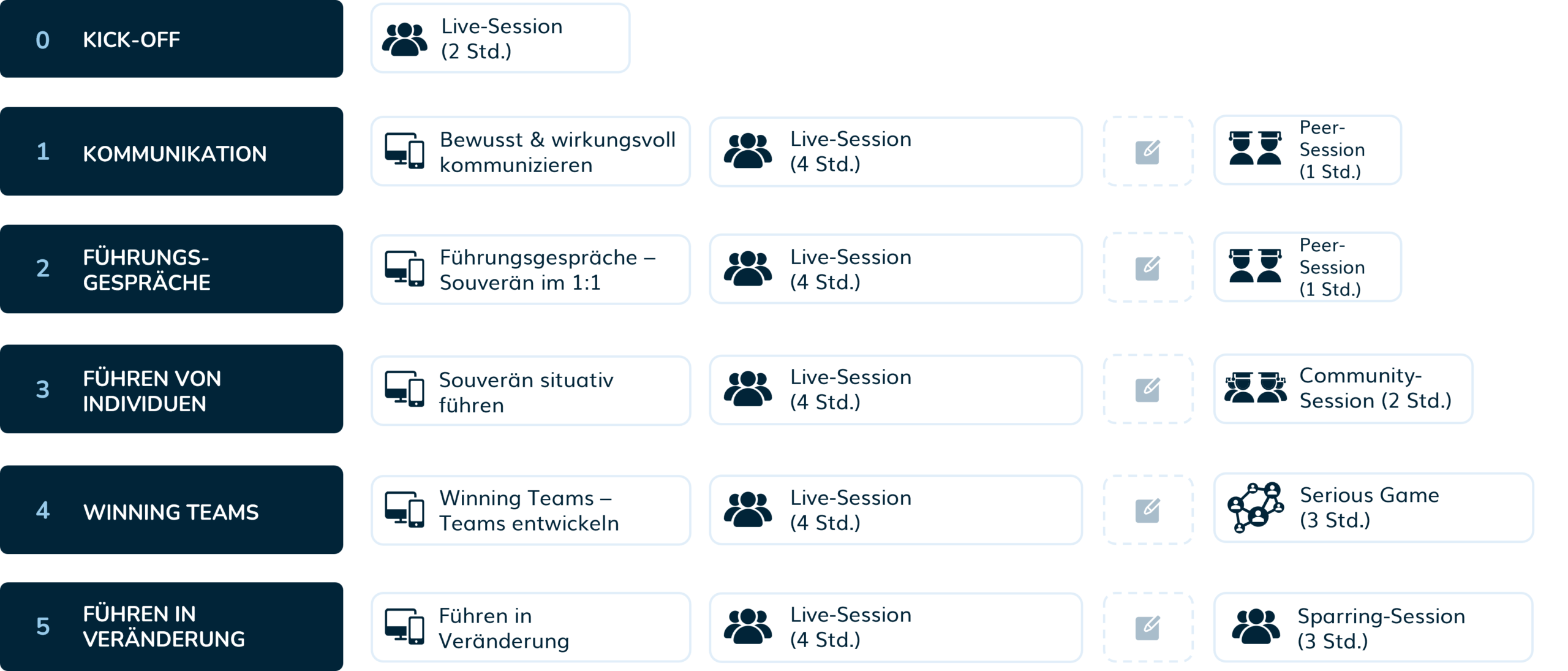
Leadership development can be designed in very different ways. Depending on the starting point, the organization, and the level of leadership experience, content and formats are selected based on specific needs. troodi’s open leadership development program runs over six to eight months and equips leaders with the essential fundamentals of leadership. From intentional communication and confident conversations to leading entire teams, participants develop an empathetic, performance- and results-oriented understanding of leadership.
The structure combines multiple learning formats into a holistic development process. It includes clearly structured modules with several components:
- Digital learning program for knowledge acquisition,
- Live session with a trainer for deeper exploration and case work,
- Clearly defined application phase for transfer into the work context.
With a deliberate time gap after the training, each module concludes with one of the following components:
- Asocial learning unit such as a peer or community session for reflection and exchange of experiences
- A serious game for a playful transfer of learning content
- Sparring session for personal reflection with the trainer
“Since troodi has become our trusted partner for leadership training, I have noticed a positive change in communication within our team. Conversations are now more structured, clearer, and more efficient. Everyone who has participated in the program uses the tools from the training on a daily basis. Personally, I consider this to be the best program I have ever taken part in. I am more convinced than ever that all the insights and tools I have gained will have a lasting impact on me as a leader, on how I am led, and on all my future conversations.”
Understanding leadership development as a long-term process
Blended learning journeys combine digital flexibility with personal interaction. When designed effectively, they enable sustainable competency development and real behavior change in everyday leadership.